



Hofbräu Festzelt 2026
The Steinberg family has been running the tent since 1980.
Silja Steinberg has been managing the day-to-day operations since 2022.
Tent dimensions:
- Length: 85 m
- Width: 62 m
- Ridge height: approx. 13 m
- Crown: 3 m
- Tent area: approx. 5,210 m²
- Garden: approx. 2,365 m²
- Total ground floor area: approx. 7,600 m² (=500 m² larger than a soccer field)
- Total area including galleries and garden: 13,700 m²
- Total roof area: approx. 5,000 m²
- Stage size: 40 m²
Tent capacity:
- Seating inside: 4,473
- Seating on balconies: 1,544
- Standing area: 940
- Seating in garden: 3,034
- Total capacity: 9,991
- Tent equipment: 7 boxes, 38 bar tables, approx. 900 tables with seats
- Daily visitor numbers: approx. 16,000 to max. 25,000 visitors
- Total number of guests over 16 days: approx. 250,000
- Number of waiters/waitresses: 280
- Kitchen: approx. 50 employees
- Wiesn office: approx. 15 employees
- Musicians: 24 people
- Number of security staff: 85 to 90 people (at peak times)
- Cleaning staff: approx. 60 people
Special features:
Tent decoration: 600 kg of hops
The only Oktoberfest tent with a standing area
Large, rotating “Aloisius the Angel” in the center of the tent
The waitresses are all uniformly dressed in blue dirndls and blue and white checkered aprons, which are made in Bavaria.
The waiters serve in lederhosen, traditional shirts, and vests.
Three waitresses or waiters work together in a team “on one wallet” and share 12 tables.
For the safety of guests, the tent has been monitored by 32 HD cameras inside and outside since 2016
Costs for setting up and dismantling the festival tent::
- approx. € 2 million
- Personnel approx. € 2 million
Before the curtain rises, 60 men have 60 hard days ahead of them: the Hofbräu festival tent is constructed from 350 tons, 20,000 building elements, and 1.6 million individual parts.
The crown:
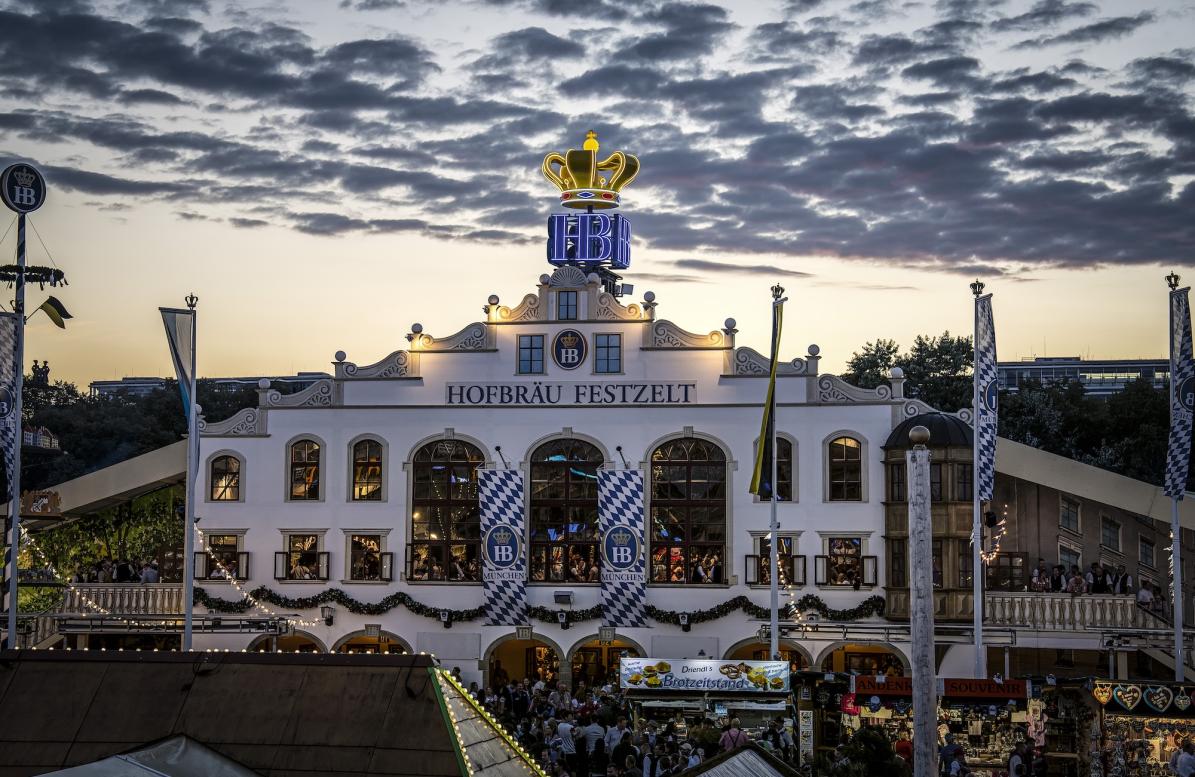
The crown has been on the roof of the tent since 1989. It is three-dimensional, visible from all sides, and permanently fixed.
Total height: approx. 3.0 m
Weight: approx. 1,000 kg
Lighting: approx. 120 m of flexible LED light strips in custom-made, colored cable ducts and acrylic glass applications with a total power consumption of approx. 1,050 W and 100 mA.
The crown stands on a steel structure at the ridge of the tent, 13 m above the ground.
Assembly: After assembly on the ground, the crown is hoisted upwards using a mobile crane.
The beer mugs:
Around 70,000 beer mugs or 1.0-liter Isar Seidel mugs are used at Oktoberfest. After Oktoberfest, around 20,000 of these remain intact. Despite the excellent work of the security team, around 7,500 of the 50,000 missing mugs are taken home as souvenirs by visitors, while the remaining 42,500 are broken.
The figure of angel Aloisius:
The Aloisius in the Hofbräu tent consists of four parts: the cloud bench, the torso, the head, and the wings. It is 350 cm tall and weighs 150 kg. The material used is extruded hard foam with a dispersion coating and an additional coat of flame-retardant fire protection agent. Thanks to a motor, Aloisius continuously rotates (in 1 min 20 sec) around its own axis.
Thanks to a motor, Aloisius continuously rotates (in 1 min 20 sec) around its own axis.
The figure of Aloisius in the Hofbräu tent was based on the figure of the “Munich man in heaven” from the animated film version by Walter and Traudl Reiner from 1962. The number of bras or pieces of underwear has decreased significantly in recent years. While at the height of its popularity, around 1,000 pieces of underwear found their way from the standing area in front of the stage to Aloisius during Oktoberfest, the number is now no more than 100.
Band Alois Altmann and his Isarspatzen:
Approximately 24 musicians in total
Performance time: 11:00 a.m. to 10:30 p.m.
Instrumentation: trumpets, clarinets and saxophones, tenor horn, trombone, tuba, electric bass, drums, keyboard, guitar, vocals
Alois Grob is responsible for ensuring the optimal sound in the Hofbräu tent.
The average age of the musicians is approximately 33.
Each musician plays for around 190 hours over 16 days.
Number of pieces of music performed: approximately 340
The band splits into 4 groups on Sundays and public holidays. This means that guests can be entertained with music from 11:00 a.m. until closing time at 10:30 p.m.
The individual “bands”:
- Afternoon: 12 musicians, 45-minute break / 12 musicians on stage
- Evening: 24 musicians on stage
- In the evening program, the combo ensemble with 8 musicians and singers can then devote itself to the individual music parts (rock, etc.), possibly enhanced with individual brass instruments.
Until around 6:00 p.m., the focus is on traditional brass music in the spirit of the Organizer - the city of Munich. From 6:00 p.m. onwards, the music program will become more international and rock-oriented. The “Prosit der Gemütlichkeit” will be played about four times per hour. The music must not exceed 85 db before 6:00 p.m. or 90 db after 6:00 p.m.
What will be consumed in 16 days? (2025 figures)
- 582,500 liters of Hofbräu beer (equivalent to 5,825 hectoliters)
- 60,000 half roast chickens
- 5,000 portions of pork knuckle
- 3,500 portions of pork sausages (equivalent to 7,000 sausages)
Hofbräu München Oktoberfest beer:
Brewing begins: in April
Alcohol content: approx. 6.3% vol.
Original wort: approx. 13.6-13.9% by weight
Kcal/liter: 480-510
Characteristics: smooth, malty, full-bodied, strong, palatable, slightly bitter
Color: golden yellow, slightly darker than light beer
Culinary: The malty-sweet and full-bodied character is ideal with traditional Bavarian cuisine.
Total quantity of Hofbräu Oktoberfest beer in 2025: 5,090,000 liters (50,900 HL)
Of which 5,825 HL or 11 percent at Oktoberfest (equivalent to 582,500 liters of beer)
Distribution in 2025 (50,900 HL):
Keg: 38.6 %
Bottle: 49.9 %
Tank: 11.5 %
Of which exports: 56.9 %
Hofbräu Oktoberfestbier will be available from the beginning of August in well-stocked stores and specialist beverage retailers (throughout Germany, mainly in urban areas). It will be available to restaurateurs from the beginning of September. Our export countries will also be supplied with Oktoberfestbier..
Oktoberfest schedule throughout the year:
March: Reservations begin
July: Tent construction begins
Early September: Reservation office at the Wiesn
October: Tent dismantling
How many toilets are there?
There are a total of 67 toilet cubicles available for women. For men, there are 26 individual urinals, 60 meters of urinal trough, 20 toilet cubicles, and one accessible toilet
Is the beer still served from wooden barrels?
No. The traditional team of six brewery horses pulling the Wiesnwirte parade only shows us how beer used to be brought to the Theresienwiese. Today, beer is served from 70 and 50 hectoliter tanks (7,000/5,000 liters). Thirteen of these tanks are located in the Hofbräu tent. At bar one and the east gallery there are three tanks with 70 hl and 50 hl, at bar two there is one tank with 70 hl and two tanks with 50 hl, at bar three there are three tanks with 70 hl, the west gallery is supplied by bars 2 and 3, in the garden there are 3 tanks with a capacity of 70 hl each, and in bar four there is 1 tank with a capacity of 70 hl. This gives a total capacity of 830 hl. As these tanks cannot be filled to the brim due to the pressure, there is around 780 hl of Oktoberfest beer in the festival tent every day. The thick walls of the tanks with 20 cm thick insulation ensure that even in direct sunlight, the temperature of the beer only rises by 1 degree per day. In addition, the large tanks have the advantage that the beer can always be tapped smoothly.
How does the beer get into the tanks?
No vehicles are allowed on the Oktoberfest grounds between 9 a.m. and midnight. This applies to all suppliers, including our “beer tankers.” At midnight sharp, the first tanker truck arrives at the first beer tent. Here, all tanks are filled in sequence using a type of high-pressure fire hose, which takes about 20 minutes per tank. The temperature of the beer during filling is between 1 and 3 degrees Celsius. Every night, a tanker truck with a capacity of up to 270 hectoliters transports the beer from the brewery to the Wiesn so that all tanks are filled again the next morning.
Interview with master brewer Rolf Dummert
Can you tell us the recipe for Hofbräu Oktoberfest beer?
There's nothing to reveal because there is no definitive recipe. Brewing beer cannot be compared to producing a soft drink. The raw materials for beer are not standardized; they come directly from nature. As with wine, the quality of barley or hops can vary depending on the vintage. The brewer has to adapt the production process to the raw materials and compensate for fluctuations. Beer is a living product.
What do you base your decisions on then?
Every brewery has its own house flavor, a so-called aroma profile. It is the brewer's art to ensure that the result always tastes the same to beer lovers. The brewer preserves the aroma profile, so to speak.
Does Hofbräu Oktoberfest beer still taste the same today as it did back then?
Definitely not. Brewing science is constantly improving technology, for example through the possibilities offered by gentle production processes. This also changes the taste, making it smoother and more pleasant. The beers from the early days of Oktoberfest would probably no longer meet our expectations today.
ou can find all materials related to the press release available for download here: